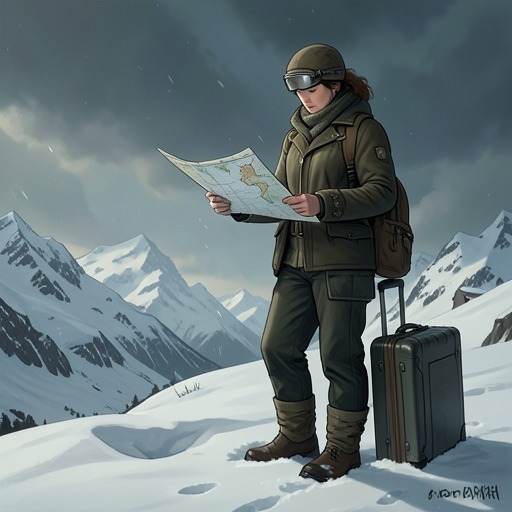
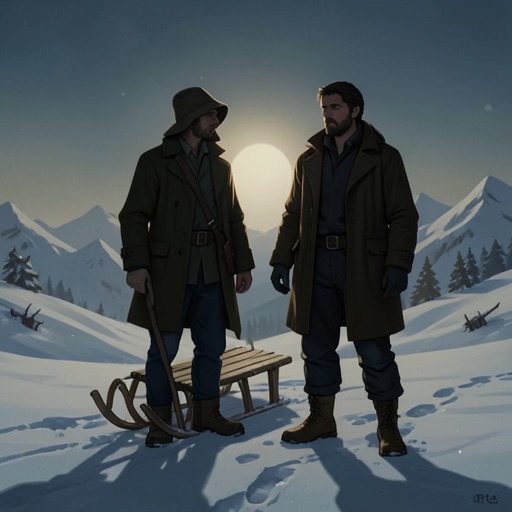
Bee and Elgie’s Antarctic Voyage
Where'd You Go BernadetteBee and Elgin Branch’s Antarctic voyage begins as a crossing from Ushuaia and turns into an investigation of Bernadette Fox’s disappearance. Bee studies the ship’s records for signs of her mother, while Elgin tries to frame the journey as an opportunity for closure. Their competing interpretations of Bernadette’s behavior strain the trip, but a clue involving a drink order and the RV Laurence M. Gould gives their search a possible direction toward Palmer Station.
Departure and the dispute over closure
The ship’s engine rumbles as Bee settles into a narrow bunk in the small room she shares with her father. Over the public-address system, the Kiwi announces that the Antarctic adventure has begun and describes the traditional bon voyage meal: roast beef and Yorkshire pudding, to be served after orientation. Bee refuses to attend. Sitting at dinner with Elgin would mean confronting the tension between them, so she takes out the Captain’s Report instead. Her first choice on the voyage is not to join the group’s ceremony but to search the record for traces of Bernadette.
The report becomes the center of an argument about what the journey is for. Elgin says they came because Bee wanted closure. Bee admits she had said that to trick him: she wants to find her mother, not settle for an explanation of her absence. She reads the report optimistically, taking Bernadette’s activities as evidence that she enjoyed the trip, chose to remain in Antarctica, and wrote a letter so Bee would not worry. Elgin offers a darker reading. Bernadette’s solitary habits and her drinking, he argues, do not suggest a carefree holiday; he sees them as signs that she was drinking herself to death. He also recalls that her letter was largely filled with paranoid complaints about Audrey Griffin. The same record thus becomes a contest between hope and alarm, and between a daughter’s search and a father’s attempt to name the loss.
The crossing and the first landfall
As the ship approaches Antarctica, Bee tries to sleep through the crossing by taking pills that she knows will knock her out, rather than because she is seasick. When she wakes, she sees choppy black water, a black sky, a lone seabird, and a large piece of ice drifting past—the first indication of the land ahead. She takes more pills and returns to sleep. The ship’s wake-up music, Michael Jackson’s Man in the Mirror, gradually grows louder before the Kiwi announces the arrival at Antarctica.
The announcement gives the voyage a precise geography. The ship first sighted land at 6:23 a.m. near Snow Hill Island and is making its way into Deception Bay; Zodiac trips are due to begin at 9:30. Bee pulls open the window shade and sees a black rocky island capped with snow beneath a gray sky. Her stomach tightens, and she imagines the continent as a place that rejects her presence. The arrival is not yet a reunion or an answer. It makes the distance between her and her mother more palpable even as the search reaches the landscape where Bernadette may be.
Reading the route and the records
Bee’s investigation depends on comparing fragments rather than finding an explicit explanation. The Captain’s Report records a $433 charge at the gift shop a few hours after Bernadette boarded, but the bill is not itemized, leaving Bee without a clear account of what her mother bought. She searches the ship’s records because she expects some small detail to stand out to her, though she does not yet know what the clue will be. Her attention turns routine documentation into a possible map of Bernadette’s movements.
At Palmer Station, the limits of that search become clearer. Charlie, a naturalist, explains that scientists are permitted to come aboard the ship for a drink as a tradition, but that station places are scarce: people apply five years ahead, and beds and supplies are limited. A Seattle mother would not arrive there casually. At two in the morning, Elgin brings Bee to the lounge, where Palmer scientists have come aboard. He has reconsidered what it would mean if Bernadette’s identification card showed her still on the ship: she might have disembarked later without scanning out, leaving others to assume she had disappeared aboard the vessel itself.
The Palmer Station lead
Bee recalls that Neko Harbor was the last place Bernadette left the ship and that the card scan showed her returning. Elgin’s new theory is that she could have gone ashore again later without recording her departure. A woman at the bar orders a pink penguin, prompting Bee and Elgin to reconsider the pink penguins mentioned in the Captain’s Report. They conclude that the drinks may have been for a scientist being dropped off at Palmer Station—someone Bernadette had befriended—rather than for Bernadette herself. The distinction changes the report from apparent evidence of her social life into a possible clue about a connection aboard another vessel.
Bee notices that the ship’s route, as she remembers it, did not come near Palmer Station. She and Elgin hurry to the chart room, where a map of the Antarctic Peninsula displays their voyage as a dotted red line. Bee finds the map dated December 26, identifies it as the trip her mother took, and weighs down its corners. Then she recognizes the name of a ship outside the window: the orange-hulled RV Laurence M. Gould. Elgin points out that it crossed paths with Bernadette’s ship and is now at Palmer Station. The voyage ends this stage of the search with a credible route to pursue, not proof of Bernadette’s whereabouts; Bee is afraid to say aloud what the discovery may mean.